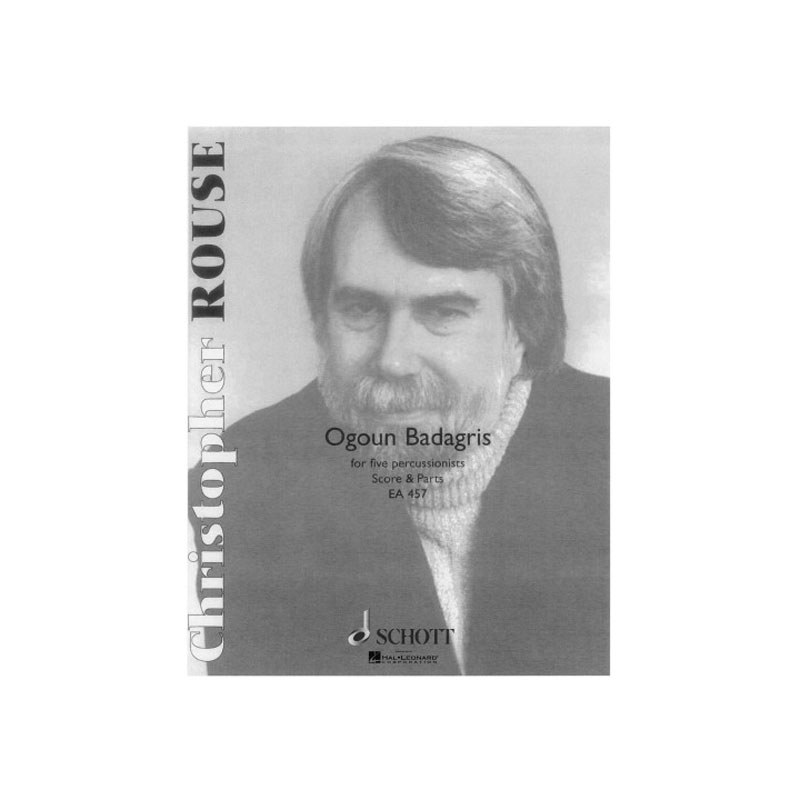
Christopher Rouse's Ogoun Badagris is a piece for five percussionists - and it's also the name of a Voodoo god that demands human sacrifice! Dark and frenetic, this piece will add some primal energy to your percussion ensemble concert.
Essentially a dance, each player will have to get a sense of the whole rhythmic pattern as it's layered between the different players. Some more advanced time signatures change up the feel from time to time, to keep everybody on their toes. I hope your players aren't shy about screaming and yelling!
Difficulty: Medium +
Duration: 5:00
Instrumentation:
- Player 1:
- Snare Drum, Timpani (4), Gong
- Cowbells (2), China Cymbal, Suspended Cymbal
- Player 2: Bass Drum, Bongos (2), Timbales (2)
- Player 3: Lion's Roar, Congas (4), Wood Blocks (3)
- Player 4:
- Bass Drum, Toms (3), Vibraslap
- Maracas, Large Ratchet
- Player 5:
- Quica, Tenor Drum, Log Drums (4)
- Sleigh Bells, Slapstick, Metal Plates (3)
- Guiro, Cabasa, Suspended Cymbal
From the composer: Ogoun Badagris derives its inspiration from Haitian drumming patterns, particularly those of the Juba Dance. Hence, it seemed logical to tie in the work with various aspects of Voodoo ritual. Ogoun Badagris is one of the most terrible and violent of all Voodoo loads (deities) and he can be appeased only by human blood sacrifice. This work may thus be interpreted as a dance of appeasement. The four conga drums often act as the focal point in the work and can be compared with the role of the four most basic drums in the Voodoo religion ? the be-be, the seconded, the maman, and the asator. The metal plates and sleigh bells are to a certain extent parallels of the Haitian ogan. The work begins with a brief action de grace, a ceremonial call-to-action in which the high priest shakes the giant rattle known as the asson, here replaced by cabasa. Then the principle dance begins, a grouillere: this is a highly erotic and even brutally sexual ceremonial dance which in turn is succeeded by the Danse Vaudou at the point at which demonic possession occurs. The word "reler," which the performers must shriekat the conclusion of the work, is the Voodoo equivalent of the Judaeo-Christian "amen".