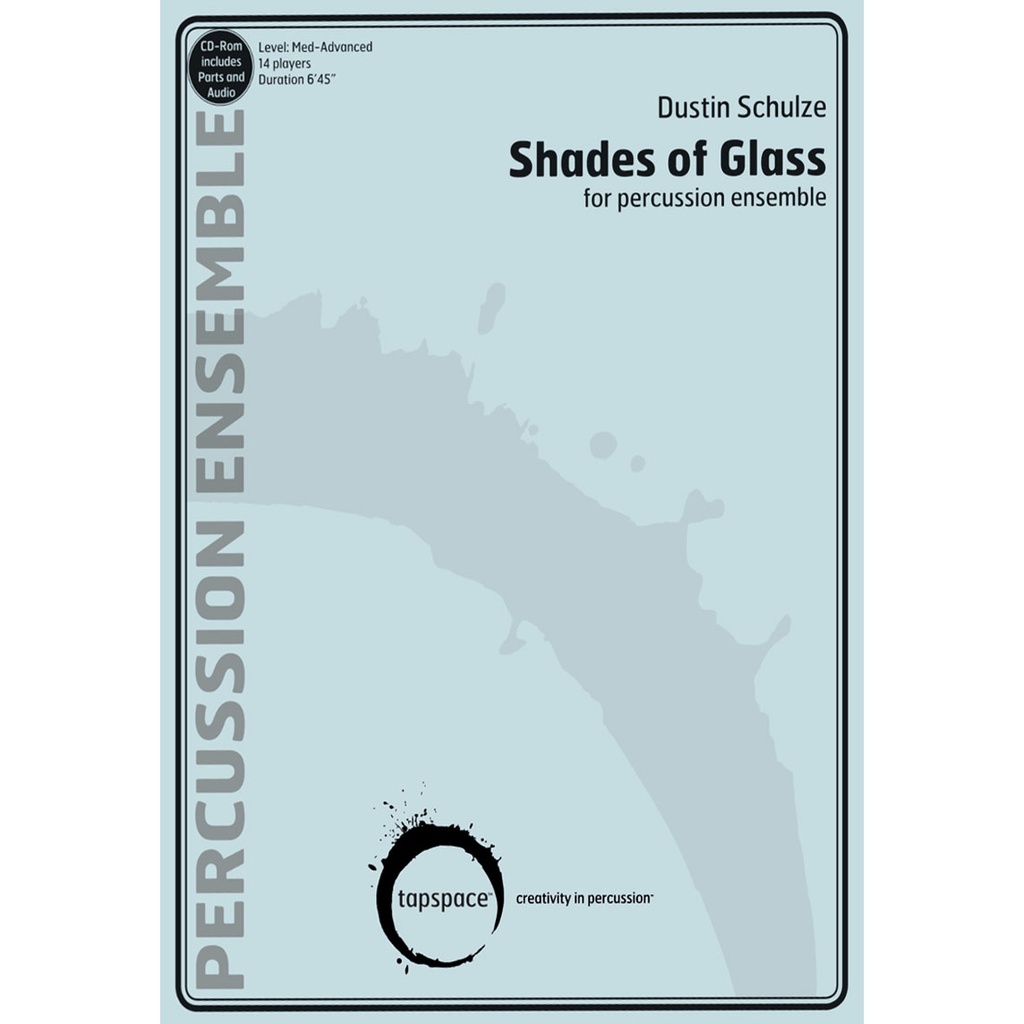
Shades of Glass for large percussion ensemble has its roots deeply cemented in the minimalist music of composer Philip Glass. Common minimalist techniques like the use of repetitive phrases and slowly changing textures abound, but Schulze adds a grooviness to keep it from being too hypnotic.
The piano player is the foundation of the piece, and all players need to be very sensitive in terms of balance, blend, and timing. Even with advanced players, the most difficult challenge can be simply keeping your place and knowing where you are in the music!
Included with this piece is a full, bound score and a data CD including individual parts and an mp3 recording.
This piece is a unique mixture of pop and minimalism, and audiences will certainly enjoy all seven minutes of it. Advanced high school or college ensembles can handle Shades of Glass. If you want a real challenge, do it without a conductor!
This piece includes the full, bound score and a data CD containing individual parts (for printing) and an mp3 recording.
Difficulty: Medium +
Duration: 6' 45"
Instrumentation
- Player 1: Piano
- Player 2: 4.3-Octave Marimba
- Player 3: 4.3-Octave Marimba
- Player 4: 4.3-Octave Marimba
- Player 5: 4.3-Octave Marimba
- Player 6: Vibraphone
- Player 7: Vibraphone
- Player 8: Vibraphone
- Player 9: Bells
- Player 10: 2-Octave Crotales, Chimes
- Player 11: Timpani (4 or 5)
- Player 12: Percussion 1
- Bongos, Concert Toms (4), Claves
- Hi Hats, Suspended Cymbal, Riveted China Cymbal
- Player 13: Percussion 2
- Concert Snare, Congas, Low Tom
- Suspended Cymbal, Crash Cymbal, Splash Cymbal
- Concert Bass Drum (shared)
- Player 14: Percussion 3
- Triangle, Castanet Machine, Roto Tom Frame (optional)
- Suspended Cymbal, Splash Cymbal, Finger Cymbals, Hand Cymbals
- Concert Bass Drum (shared)
From the composer: This piece was initially inspired by the music of Phillip Glass. I sought to create an elaborate piece for a large percussion ensemble that utilizes repetitive, overlapping rhythms that, when put together as a whole, create a hypnotic sense of euphoria. There are many different 'shades' to this work, including some that walk along the edge of 'absurdity'. The hope is for the listener to feel entranced, while at the same time not really knowing the possibilities that lay ahead. This ensemble is meant to portray a layered musical landscape that is representative of a surreal, dreamlike state. - Dustin Schulze